SEO, Meet GEO
Remember when every business needed a website? Then we needed to be on Google. Then Facebook. Instagram. Google Ads. Search Engine Optimization. Well, you still need those things – but something new has entered the group chat.
The way people search for information online is changing — quickly.
Instead of opening Google and typing “best restaurant near me,” “gift for a new baby” or “where can I get business cards printed,” more consumers are asking those questions directly to AI tools like ChatGPT. Now they aren’t getting a page full of links to sort through, they’re getting an answer. That changes things for businesses.
You may already be familiar with SEO, or Search Engine Optimization. SEO is the work businesses do to help their websites and information show up when someone searches on Google or another traditional search engine. Now there’s another acronym entering the chat (literally): GEO, or Generative Engine Optimization. “GEO” is the work businesses do to make their information clear, credible and accessible enough that these AI systems can find it, understand it and potentially use or cite it when answering a question.
A generative engine is an AI-powered system that takes your question and generates an answer, often by pulling together information from multiple sources.
In the simplest terms: SEO helps you show up in search results. GEO helps you show up in AI-generated answers.
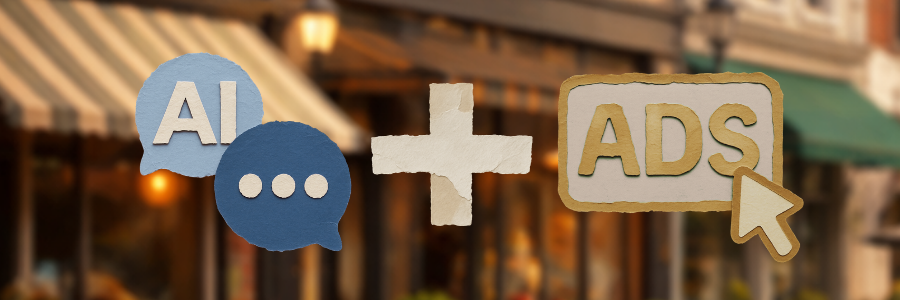
And yes, businesses can now advertise on ChatGPT, too. ChatGPT Ads give advertisers another opportunity to reach consumers while they are researching, comparing products and making decisions. Much like businesses have purchased Google Ads to appear alongside searches, advertisers can now purchase sponsored placements that appear alongside ChatGPT conversations.
That distinction is important: businesses cannot simply pay ChatGPT to make the AI say their product is the best. Sponsored advertisements are separate from ChatGPT’s answers and are labeled as ads. But businesses now have two reasons to start paying attention to AI: earning visibility in the answer and purchasing visibility around it.
For small businesses, this is one of those moments when marketing and technology seem to be moving at the speed of fiber internet. And, like most new technology, getting in early isn’t necessarily cheap. Some of these emerging advertising and optimization products may be cost prohibitive for the smallest businesses right now. That doesn’t mean you should ignore what’s happening.
Start thinking about whether AI can understand your business.
- Is your website current?
- Does it clearly explain what you sell and where you are?
- Can someone easily find your hours, products, services and contact information online?
- Are other credible websites talking about your business?
The internet has spent decades learning how to make businesses searchable. Now we’re learning how to make them understandable to AI.
There is another side to this shift, too: we’re not just business owners and marketers. We’re consumers. We need to understand how the information in front of us gets there. AI can be incredibly useful for researching products, comparing options and helping us make decisions. As advertising becomes part of that experience, consumers should understand the difference between an AI-generated recommendation and a clearly labeled paid placement. We should also recognize that businesses are actively working to make their information easier for AI to discover — just as businesses have spent years working to appear higher in Google search results. That’s marketing. And it isn’t necessarily a bad thing.
As consumers, we’re increasingly being shown products and information that align with what we’re actually looking for.
As businesses, we have an entirely new place to meet customers while they’re making decisions.
That’s exciting.
And because this is Marketing on Main Street a Cookson Hills Publishers column, I’ll end with a shameless plug.
Cookson Hills Publishers is already bringing these emerging digital marketing products to local businesses. That’s part of what it means to be a community marketing partner. The tools are changing quickly, and our job is to keep up with them so our local businesses don’t have to figure it all out alone. The way people search is changing.
The question for your business is whether you’ll be there when they ask.
Main Street marketing, done right.
Until next time,
Alice